
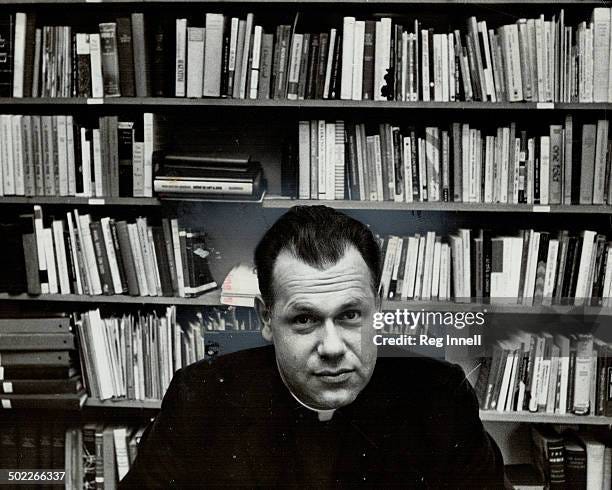
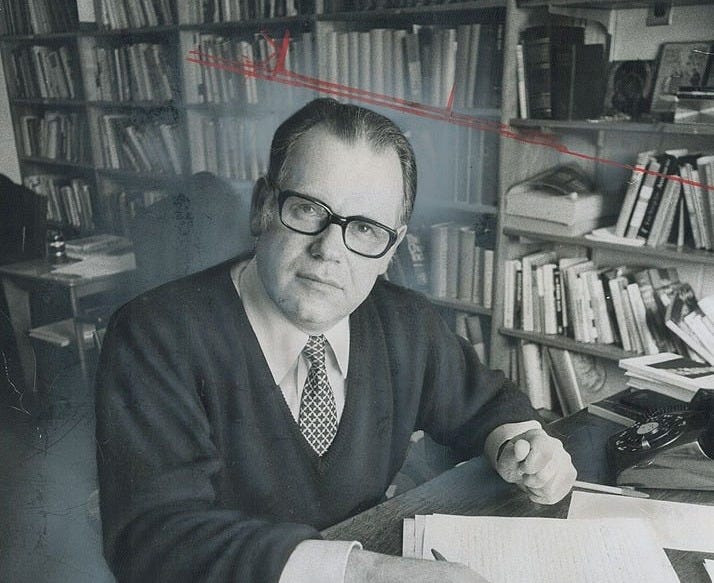
The stances of Gregory Baum, O.S.A., on women’s ordination, Liberation Theology, Marxism and Communism,1 dual-covenant theology and Jewish conversion (or the needlessness thereof),2 the ongoing evolution of human sexuality,3 and the necessity of the Church’s self-abasement for past “misdeeds,”4 as well as his affiliation with the Dutch Documentation Center (a short-lived but influential focal point for liberal Catholic efforts around the time of the Council),5 his personal sexual proclivities,6 his opposition to Humanæ vitæ, and his 1974 laicization and marriage, are sufficiently well known to be passed over here. What is of interest to me are his words concerning the proper interpretation of the documents of Vatican II—upon three of which, namely Nostra ætate, Unitatis redintegratio, and Dignitatis humanæ (the first above all), he exercised some influence as a peritus at the Council.7
His thoughts on the matter come from his introduction to an early English-language collection of the documents of Vatican II published by the Newman Press (later absorbed into Paulist Press).8 They will, I think, serve for a reminder of how one must approach these documents.
The authority and future influence of the documents.
He begins with an assertion of the documents’ supreme doctrinal authority—they “are the expression of the highest teaching authority of the Catholic Church”—before triumphantly predicting the enormous influence which they will exercise upon the Church: “They will affect the Church in almost every aspect of her life. The documents will be read, studied, and appropriated by the Catholic people. They will determine the teaching of theology at seminaries and universities, they will influence the preaching in the parishes, they will accelerate the catechetical renewal, and they will create a new Christian spirituality adapted to the exigencies of the present.” And further on, he reaffirms the same: “There is no area of theology that has not been profoundly affected by the doctrinal development of Vatican II. Whatever theological subject is being taught or studied, the relevant conciliar documents will have to be consulted.” We remember here that this introduction was penned only a year after the Council was closed, its participants ebullient and ready to implement its provisions back home.
He cautions readers about the potential for “opposition to the conciliar renewal,” but rests easy in the assurance that things will work out, for “[t]he Catholic Church… is not a communist party, where a new approach from the top is swallowed without question by the followers.”9 Thus the post-conciliar Church, Baum predicts, will be a listening Church. (To whom this listening Church will turn its ears is another issue entirely.)
“Extraordinary doctrinal development.”
Immediately after this aside, we are told of “[t]he extraordinary doctrinal development and the disciplinary changes initiated by the Vatican Council,” of which the prime examples are found, he says, in Unitatis redintegratio, Nostra ætate, and Dignitatis humanæ (documents which he had much experience with at the Council): “No theological commentary is necessary to convince the reader that the teaching contained in these documents is really new, i.e., represents an extraordinary doctrinal development and thus transcends the official ecclesiastical teaching of the past.” These “extraordinary” changes had already been noted by Baum—who hoped they would arise in every area of post-conciliar Church teaching—in his coverage of the Council’s final session, published the year prior in Commonweal.10
The strength of his convictions about changes wrought by the Council are repeated in his words on Gaudium et spes, a document which “presents the new attitude of the Church to the world.” Moreover, “According to the conciliar teaching, the Church of Christ is open to the values of the world.” The mid-century optimism which colors almost every aspect of Vatican II (about which many today have complained) makes Baum’s words appear bright and untarnished, for the ugly trajectory which history had visibly and unapologetically adopted in 1914 and which would continue to steepen by century’s end had not yet made itself obvious enough for such men.11
Now, I note here that there are two primary interpretations of Baum’s judgements regarding the novelty of the conciliar documents: the first is simply that he is correct, that they signify a turning point, if not a rupture, in Church history and teaching; the second is that he is wrong, and that he (along with the CIA-media complex operating in high gear throughout the Council’s proceedings) is merely uttering the desires of liberal Catholics. During the Council, the media attempted to influence the bishops into bringing into being what they (the media) said was going on, or would happen, or should happen, etc.12 Baum could be neatly situated in the context provided by this strategy, which continued to be exercised after the Council.
More nuance can be exercised in discerning the truth here. I make no judgement, however, and want only to provide the reader with the information needed to make his own choice.
“The documents have a history.”
But to return to Baum’s introduction, after pointing out the high points of Sacrosanctum concilium, Dei Verbum, Lumen gentium, Apostolicam actuositatem, Præsbyterorum ordinis, and Christus Dominus, he introduces us to the exegetical key to the documents as a whole, viz., that they are living documents inextricable from their conciliar history and therefore cannot be interpreted apart from this history; they are not dead letters.
Three aspects of study constitute this exegetical key. They are not explicitly numbered by Baum, as I have done below, but they are, I argue, there by necessity if one reads the introduction closely and applies the principles to the facts.
The first, which is the use of commentaries, grants us access to the second and third aspects simply by giving us contextual information. The second aspect of study is an understanding of the conciliar debates which shaped the evolution of the final documents: “[T]he documents have a history,” he says, therefore “it is through an understanding of their evolution at the Council that the salient points of the conciliar teaching are brought out.” The third aspect of study is tightly related to the second: one must know the motivations of the Council participants to know the meaning of the words of the published documents. Only then can one really understand them: “Some themes proposed in the documents acquire their power only if we realize the great significance which the bishops attached to them in the conciliar debate.” It is only natural and necessary, I must add, to include under this third aspect of study the thoughts and motivations of the periti at the Council.
An example in Lumen gentium’s treatment of collegiality.
“This point,” says Baum, “is so important that I must give a few examples,” of which the first is the most instructive. Lumen gentium’s treatment of the episcopacy (ch. 3) “proposes the doctrine known as episcopal collegiality. Reading the definitive text of the Constitution,” he continues, “we are surprised that this doctrine is not very strongly emphasized in it. … Yet when we study the history of the document, the earnest discussions at the Council, the first vote on the principle of collegiality, the development of the text and the subsequent votes [in all which points one necessarily treats of the second and third aspects of study described above], then it becomes clear that the doctrine of collegiality, even though not central in the text from a literary point of view, is, nonetheless, the essential theme of chapter three and one of the main issues of the entire Council.” And again, further on, he repeats himself in another example taken from the same constitution’s eighth chapter: “To understand the meaning of this chapter, therefore, it is important to study its history.” It would be difficult to state with any greater clarity the principle that the Council documents are not dead, bare letters to be read in isolation, but rather are informed by their contexts and cannot be fully interpreted without such information. One cannot dismiss considerations of the Council’s history or the motivations and opinions of its participants without doing great violence to the proper study of such documents and of the Council itself.
Baum’s interaction with Marxism and Communism is well known (see, e.g., his memoir The Oil Has Not Run Dry: The Story of my Theological Pathway (McGill-Queen’s University Press, 2017), Footprints Series, ed. by Jane Errington, vol. 23). H. J. A. Sire, however, states that he was a member of the Communist Party, which is, frankly, an enormous leap to make without citing any proof (Phoenix from the Ashes: The Making, Unmaking, and Restoration of Catholic Tradition (Angelico Press, 2015), p. 183; but cf. p. 187, where Baum is merely called a Marxist). If any readers know anything more on the matter, please do let me know.
“Jesuit [sic] Theologian Declares Christians Must Cease to Seek Conversion of Jews,” Jewish Telegraphic Agency, 7 February 1968, p. 4, online.
The ongoing evolution of human sexuality is a notion which Baum praised in the thought Teilhard de Chardin, S.J. (see the quotation of Baum in Atila Sinke Guimarães, Destructio Dei, 1st edn. (Tradition in Action, 2012), Eli Eli Lamma Sabachthani? (hereinafter EELS), vol. 7 p. 44, n. 6, § o); Teilhard, in turn, seems to have gotten the idea from the so-called “godfather of the New Age,” Gerald Heard, who held that this ongoing sexual evolution was marked, chiefly, by homosexuality (see David Wemhoff, John Courtney Murray, Time/Life, and the American Proposition: How the CIA’s Doctrinal Warfare Program Changed the Catholic Church (2nd edn., Wagon Wheel Press of Presence, 2022), vol. 2, pp. 8 and 11). Heard was also a promoter of LSD, supplying to people as influential as Clare Boothe Luce, wife of Henry Luce, owner of Time/Life (see ibid.).
The connections between the pushing of LSD and homosexuality, the consciousness revolution movement, the proto–New Age, Teilhardianism and evolutionary thought, and the CIA (whose fingerprints are all over the proliferation of psychedelics) are an historiographical blank spot which I should very much like to investigate in the future.
Guimarães, Ecclesia, 1st edn. (Tradition in Action, 2009), EELS, vol. 11 pp. 184 f.
Guimarães, In the Murky Waters of Vatican II, 4th edn. (Tradition in Action, 2025), EELS, vol. 1 p. 261, n. 66.
Baum, The Oil Has Not Run Dry, p. 23. On Baum’s advocation for homosexuals, see the quotation of John McNeil, S.J., apud Guimarães, Animus injuriandi II, 1st edn. (Tradition in Action, 2011), EELS, vol. 3, pp. 285 f.
Catherine Mulrony, “Gregory Baum a Link to Vatican II,” University of St. Michael’s College in the University of Toronto News & Updates, 23 October 2017, online; Stephen Bede Scharper, “Gregory Baum: A Gentle Theological Giant who Helped Open the Catholic Church,” Toronto Star, 20 October 2017, online.
Baum, introduction to The Teachings of the Second Vatican Council: Complete Texts of the Constitutions, Decrees, and Declarations (Westminster, Maryland: the Newman Press, 1966), pp. vii–xi.
This is an interesting comparison to make given the Council’s paralysis respecting a condemnation of Communism (for which see, e.g., Sire, op. cit., pp. 182–184). I make this point not to score a cheap jab, but only because of my interest in the Cold War’s influence on the modern Catholic Church. One would be very naïve to assert that the Council proceeded uninfluenced by the Cold War!
Baum, “The Final Session: Off to a Good Start,” Commonweal, 15 October 1965, p. 52; cited in Wemhoff, op. cit., vol. 2, p. 370. Msgr. Joseph Clifford Fenton’s rejection of these hopes as nonsensical and impossible are, however, worth noting (ibid.). Commonweal was an Americanist magazine, joining the chorus of adorers of John Courtney Murray (ibid., pp. 87, 93) and contributing to the frenetic clamor for liberalization which characterized media coverage of the Council (ibid., p. 167). The magazine’s editor, Edward Skillin, signed an liberal-Americanist “Statement on Religious Liberty” during the 1960 American presidential campaign (ibid., p. 61).
The words of the Rev. Godfrey L. Diekmann, O.S.B., in the conclusion to his commentary on Lumen gentium, offer themselves up as another example of this (shall we say) cheeriness: “Seeing the Church in a changing world, as they [the Council Fathers] had never seen it before, they realized that willingness to engage in reasonable experiment, to tolerate a certain state of fluidity, is the necessary condition for serving the world—and its men” (in Msgr. Vincent A. Yzermans, ed., American Participation in the Second Vatican Council (New York: Sheed and Ward, 1967), pp. 73–91, at p. 91). As I have noted in another article, this optimism lives on in Pope Leo’s encyclical letter Magnifica humanitas, nos. 23–25, 28, and 42.
Wemhoff’s second volume is the go-to resource on the matter.